Skip to content

Your cart is empty

Continue shopping

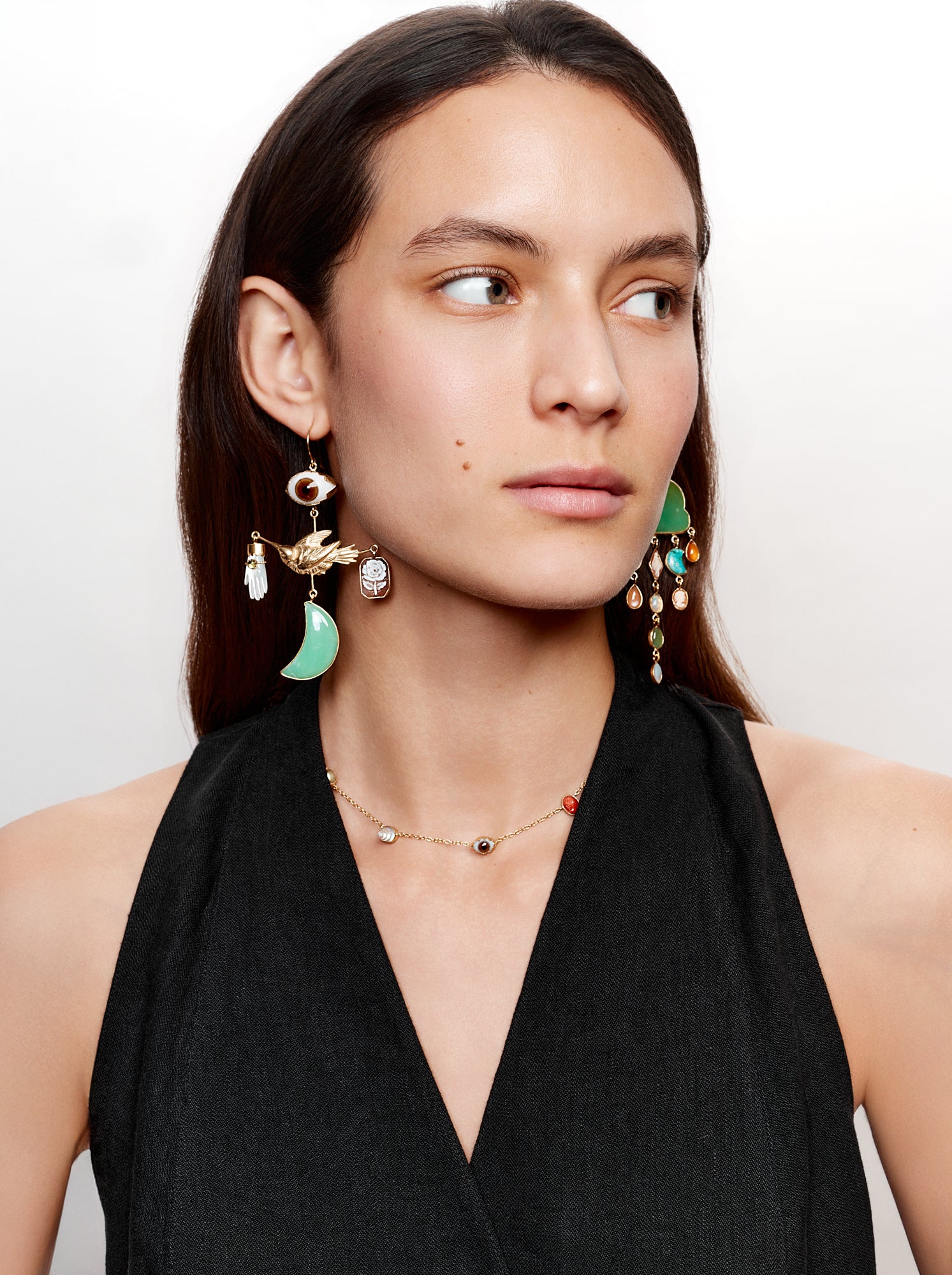
Boucles d'oreilles Bird and Cloud Drop

Tax included.

Sale price€1.882,50

Grainne Morton compose ses boucles d’oreilles comme des poèmes en suspension. Ici, un œil protecteur dialogue avec un oiseau doré en plein mouvement, tandis qu’un nuage en pierre verte structure la seconde boucle. Autour de ces motifs centraux, une constellation de pampilles — camées floraux, croissant de lune, mains sculptées, gouttes et cabochons aux teintes vertes, ambrées et ivoire — crée un rythme libre et assumé. L’asymétrie est intentionnelle, presque cinématographique, chaque élément conservant sa singularité dans un équilibre précis.

Une paire de boucles d’oreilles en pierres de couleur et éléments vintage, réalisée en pièce unique, entre talisman contemporain et cabinet de curiosités personnel.

Details
Gold-plated Chrysoprase Opal Moonstone Pearl Peridot Turquoise

Plaqué or
Camée
Chrysoprase
Opale
Verre
Pierre de lune
Perle
Péridot
Turquoise
Longueur: 12cm
Largeur: 5cm
Chaque pièce Grainne Morton est unique, fabriquée à partir d'éléments vintage, ce qui peut entraîner de légères variations d'un modèle à l'autre.

SKU: GM-E-B&CD_U
Where to buy this jewel?
Grainne Morton
Boucles d'oreilles Bird and Cloud Drop
€1.882,50
Boucles d'oreilles Bird and Cloud Drop
Boucles d'oreilles Bird and Cloud DropU Sale price€1.882,50
Grainne Morton
Like a magpie, Grainne Morton collects everything that sparkles. Inspired by her Northern Irish roots — a world of craft, folklore and antiques — she transforms found treasures into poetic jewellery compositions. Now based in Edinburgh, she has made these unexpected assemblages her signature: narrative pieces balancing memory and wonder.
Grainne Morton
Grainne Morton

What is this piece made of?

This piece contains: Gold-plated Chrysoprase Opal Moonstone Pearl Peridot Turquoise

Gold-plated

Gold-plated jewellery combines the look of gold with an accessible approach to design. It consists of a base metal — often brass or silver — coated with a thin layer of gold through electroplating. While its gold layer is lighter than vermeil, gold-plated jewellery allows for expressive shapes, playful proportions and contemporary styles at a more approachable price. Because its coating is thinner, gold-plated jewellery evolves more quickly over time. A soft patina may appear, especially on pieces worn daily or exposed to friction. Many consider this part of its charm, though refreshing the plating is always possible if one prefers to restore the original shine. How to care for it? Avoid water, perfumes, lotions and household products. Store each piece separately to protect the surface. Clean gently with a soft dry cloth — without abrasive products — to preserve the gold finish as long as possible. Gold-plated at WHITEbIRD At WHITEbIRD, gold-plated pieces appear in contemporary designs like Tom Wood pieces that play with lines, movement and volume. A material chosen for its accessibility, its brightness and its ability to bring a golden touch to everyday jewellery.
Gold-plated

Chrysoprase

Chrysoprase takes its name from the Greek krisos (“golden,” referring to its brightness) and prason (“leek,” for its distinctive green hue). Sourced from Germany, Australia, the United States and Madagascar, it belongs to the quartz family and is known for its vibrant, even colour that can evoke the purity of jade. Often cut into cabochons, chrysoprase is among the oldest documented gemstones. It is said to have been worn by figures such as Alexander the Great and Frederick II of Prussia, drawn to its luminous presence and bold green tone. Through the centuries, various traditions have associated it with harmony and calm — a stone thought to ease tensions and support emotional balance, sometimes linked to friendship and personal growth. Its vivid colour and natural freshness continue to inspire contemporary designers such as Lito, Brooke Gregson, Cathy Waterman and Ivarene, who value its bright, expressive character.
Chrysoprase

Opal

The word opal originates from the Sanskrit upala, meaning “precious stone,” later adapted into Greek (opallion) and Latin (opalus), both evoking the idea of shifting colour. This notion lies at the heart of opal’s identity: a mineral defined by its remarkable play of colour, varying from subtle iridescence to vivid, electric flashes. A distinction is commonly made between noble opals, prized in jewellery for their multicoloured brilliance, and common opals, which are often more uniform or translucent. Among the many varieties are black opal, known for its dramatic contrasts, and Mexican fire opal, admired for its vibrant orange hue. Major deposits are found in Australia, Brazil, Guatemala, Honduras, Japan, Mexico, Peru and the United States. Milky white opals with colour flashes remain among the most iconic. Opal has inspired countless legends. In India, a rainbow goddess is said to have transformed herself into an opal to escape persistent suitors. In Arabic tradition, opal was believed to be born from lightning, with the captured light trapped inside the stone. With its shifting hues and delicate radiance, opal captivates designers such as Brooke Gregson, Ivarene and WWAKE. It also features in our We by WHITEbIRD collection, where its unique luminosity reveals its full beauty through movement.
Opal

Moonstone

Moonstone takes its name from the Sanskrit words kanta (“beloved”) and chandra (“moon”), referring to the pale, shifting glow it reveals when touched by light. This optical effect, known as adularescence, creates a soft, milky radiance reminiscent of moonlight. Its main deposits are found in Armenia, Australia, Myanmar, India, Sri Lanka and the United States. In 1970, moonstone was chosen as the official gem of the state of Florida, in reference to the lunar missions launched from Cape Canaveral. Linked to Diana, the Roman goddess of the moon and the hunt, moonstone has long symbolised femininity, gentleness, motherhood and tolerance. In India, where it is considered sacred, it is said to enhance intuition and subtle perception. Its pearly, mist-like surface gives the stone a quiet, enveloping presence. Designers such as Pippa Small and Grainne Morton are drawn to its soft luminosity and serene, reflective character.
Moonstone

Pearl

Whether South Sea, freshwater, Keshi, Akoya, Melo, cultured or natural, pearls have long held a status equal to that of precious stones. Formed when a mollusc coats an internal irritation with successive layers of nacre, pearls emerge as softly glowing beads in shades of white, cream, grey or deep iridescent black. Once abundant in Tahiti’s lagoons, natural pearls declined sharply due to overharvesting and pollution, leading to the rise of pearl farming in the 20th century. They are also sourced from the Persian Gulf, Japan and the many archipelagos of the Pacific. Among the great historical pearls, La Peregrina remains one of the most remarkable: discovered in the 15th century in the Gulf of Panama, weighing nearly 56 carats, it was gifted to King Philip II of Spain, later worn by Mary Tudor and immortalised by Velázquez. In 1969, Richard Burton famously purchased it for Elizabeth Taylor, who had Cartier redesign it as a necklace. It sold at auction in 2011 for $11.8 million. Reinterpreted today by designers such as Sophie Bille Brahe, Lia Di Gregorio, WWAKE and Alighieri, the pearl continues to assert its quiet power. Its natural glow—subtle, refined, unmistakably tactile—offers a timeless balance between restraint and elegance.
Pearl

Peridot

Two main theories exist regarding the origin of the word peridot: one traces it to the Arabic faridat (“precious stone”), while another associates it with the Greek chrysos lithos, meaning “golden stone.” Its colour — a bright green shifting from yellowish tones to deeper, olive hues — led to frequent confusion with emeralds in royal collections. Like diamonds, peridot forms deep within the Earth’s mantle. It reaches the surface only through tectonic movement and volcanic activity, travelling from several kilometres underground to the crust. First discovered on an island in the Red Sea, peridot is now mined in Myanmar, Pakistan, the United States, China and Vietnam. One of the largest known examples, a 310-carat stone, is housed at the Smithsonian Institution in Chicago. Its fresh, translucent green is admired for its clarity. In various traditions, peridot is associated with self-confidence and emotional balance, its gentle luminosity said to ease tension, jealousy or nervousness. In contemporary jewellery, designers such as Christina Magdolna and Grainne Morton use peridot in subtle accents, highlighting its pure, radiant green — both bright and refined.
Peridot

Turquoise

Turquoise takes its name from the Old French turquois, meaning “Turkish,” referring to the trade route through which it reached Europe. Mined in Afghanistan, Australia, China, the United States, Iran, Mexico and Tanzania, it ranges from deep azure to vivid green. Its colour depends on its chemistry: copper creates bluer tones, chromium and vanadium produce greens, and iron introduces a touch of yellow. Containing around 18% water, turquoise can dry out, tarnish or subtly change colour over time. Its matrix patterns — where other minerals weave through the stone — give it a uniquely organic charm. Used for over 6000 years, turquoise was cherished in Ancient Egypt; Queen Zar wore it as a protective amulet. Among Apache communities, it guided hunters and warriors. Today, it remains associated with joy, optimism and emotional stability. In contemporary jewellery, turquoise is appreciated for its vibrant hues and natural texture. Pascale Monvoisin often incorporates it for its raw beauty and distinctive presence.
Turquoise

Taking care of your jewels

Pieces of jewelry are delicate little objects. Even if they are made of resistant materials in order to be worn every day, it is still important to follow some general advice for them to keep their original beauty.

Read Guide

Frequently asked questions

Looking for a quick answer? You’ll find detailed information on our Payment, Delivery and Returns & Exchanges pages. If you need any further assistance, our team will be happy to help — feel free to contact us using the form below.

CONTACT US
Do you ship internationally?

Yes. We ship worldwide from Paris with trusted carriers such as DHL Express or Colissimo. Delivery options and fees are calculated at checkout according to your destination and the value of your order.

  • France: Colissimo for orders up to €1,000, DHL Express above.
  • European Union: Prices are calculated with local VAT applied at checkout, based on the delivery address.
  • United Kingdom & United States: Import duties and VAT are included. No additional charges upon delivery.
  • For deliveries outside the European Union, customs procedures may apply depending on the destination.
When will my order be delivered?

Orders can be collected in one of our Paris boutiques, or shipped to your address.

  • In-stock pieces are usually dispatched within 2 to 5 business days.
  • Delivery times vary depending on destination and carrier.
  • For made-to-order or special pieces, production delays are indicated on the product page.

You will receive a confirmation email with tracking details as soon as your order is shipped.

Are returns or exchanges possible?

Yes. If your piece does not fully suit you, you may request a return or exchange:

  • Within 14 days of receipt (28 days for deliveries to the USA)
  • The piece must be unworn, unaltered, and returned in its original condition.

Please note that engraved, resized or custom-made pieces cannot be returned or refunded. Return shipping costs are at the customer’s expense; however, exchanged items are shipped free of charge within the European Union.

Need advice before choosing?

Our team is here to guide you. For questions about sizing, availability, gemstones or gifting, we offer personalised support by phone or email. You may also book a private video consultation (WhatsApp or FaceTime) to view pieces live, receive styling advice or explore a curated selection — just as you would in our boutiques.

  • Tel : +33 (0)1 42 60 52 39
  • Email : contact@whitebirdjewellery.com