


HOW DO WE CHOOSE A DIAMOND?
There is what the market calls a beautiful diamond. And there is what, in a stone, moves you. A rose cut, a champagne diamond, inclusions that tell a story no other will ever repeat. A diamond traced from mine to setting…
To navigate between the 4Cs and the new aesthetics reshaping jewellery, WHITEbIRD unveils this exclusive guide. To understand the diamond and choose it with conviction.


Portrait of Duchess Mary of Burgundy (1457–1482), circa 1500. From the Ambras Castle collection, Innsbruck. Artist: Niklas Reiser.

"A diamond is forever" De Beer's 1947 campaign.
A diamond is a treasure of time and nature, formed around 3.3 billion years ago. Composed of 99% carbon and created more than 150 kilometres beneath the earth’s surface, under extreme pressure and heat, it reaches us through the movements of magma.
Also known as April’s birthstone, ancient civilisations attributed magical powers to it. In Sanskrit, vajra — lightning. In Greek, adamas — the indomitable. The earliest diamonds are believed to have been mined in India over 3,000 years ago. A talisman for warriors, a symbol of spiritual clarity, the diamond has travelled through centuries, gathering meanings: absolute purity, resilience, love, something that endures and never breaks.
It was in the 15th century that the stone entered the language of love, when Archduke Maximilian of Austria offered a diamond ring to Mary of Burgundy. But it was in 1947 that a New York agency forged the modern myth. Four words, commissioned by De Beers. “ A Diamond is Forever” reshaped the Western imagination of marriage. The diamond, like love, is not meant to be resold. It remains. What jewellery designers have done since is to reinterpret this promise, restoring a depth that marketing alone could never achieve.

THE 4Cs: WHAT EXPERTS LOOK AT
To assess diamonds, the Gemological Institute of America established, in the 1950s, a universal language: the 4Cs. An essential tool, provided one understands what it reveals… and what it does not.
Colour. The scale ranges from D (completely colourless) to Z (slightly yellow or brown). In traditional jewellery, D to G stones are considered the most valuable. Yet colour is not a hierarchy of beauty. It is chosen in relation to the setting, the light, the style. But, a G diamond set in yellow gold can be more compelling than a D in platinum.
Carat. A measure of weight, 0.2 grams per carat, not size. The price per carat increases exponentially with weight, as larger stones are rarer.
Clarity. The absence of internal inclusions and surface imperfections, graded from FL (Flawless) to I3. Between VS1 and SI1, most inclusions are invisible to the naked eye, often where the best balance lies. But inclusions, as we will see, are not always flaws.
Designers such as Sophie Bille Brahe, who have made diamonds their signature, work exclusively with GVS-quality stones.
Cut. The only criterion entirely controlled by human hands, and arguably the most decisive for a stone’s beauty. An excellent cut transforms light into fire and brilliance; a poor one dulls even the finest diamond. The GIA grades cut from Excellent to Poor. Historical jewellery houses work only with the top levels.
Cut also refers to shape: round brilliant, cushion, emerald, oval, pear, marquise, radiant, Asscher… The round brilliant, with its 57 facets, is the most luminous. The emerald cut, with its clean lines, the most refined. The oval elongates the hand.


WHITEbIRD'S SIGNATURE : A DIFFERENT VISION OF DIAMONDS
Since 2010, WHITEbIRD has embodied a singular space for jewellery: a house that selects its designers instinctively, for their authenticity, their relationship to material, their refusal of convention.
At WHITEbIRD, a diamond may be crystal-clear or marked with inclusions, white, grey, yellow or champagne, set in an exceptional solitaire or in a piece closer to a wearable sculpture. What remains constant is the standard: artisanal craftsmanship, certified origins, and a gesture that speaks volumes. Across our three Paris boutiques and online, this diversity unfolds, allowing you to find the stone that feels like your own.

Pirrie Wright and her friends attending a Sophie Bille Brahe's trunkshow at WHITEbIRD Mont Thabor - Paris 1
CHOOSING A DIAMOND ENGAGEMENT RING
An engagement ring concentrates every question about the diamond, and adds a few more. In our Discover our guide to designer engagement rings, we walk you through each step of this choice.

The setting can matter as much as the stone. White gold enhances the brilliance of a colourless diamond; yellow gold warms a lightly tinted stone; a pavé setting multiplies light around a central gem.
What matters is the balance between the stone, the setting, the hand and the personality of the wearer. WHITEbIRD’s engagement selection brings together designers who each offer a singular interpretation of this meaningful piece.


2026: ALL EYES ON COLOURED DIAMONDS
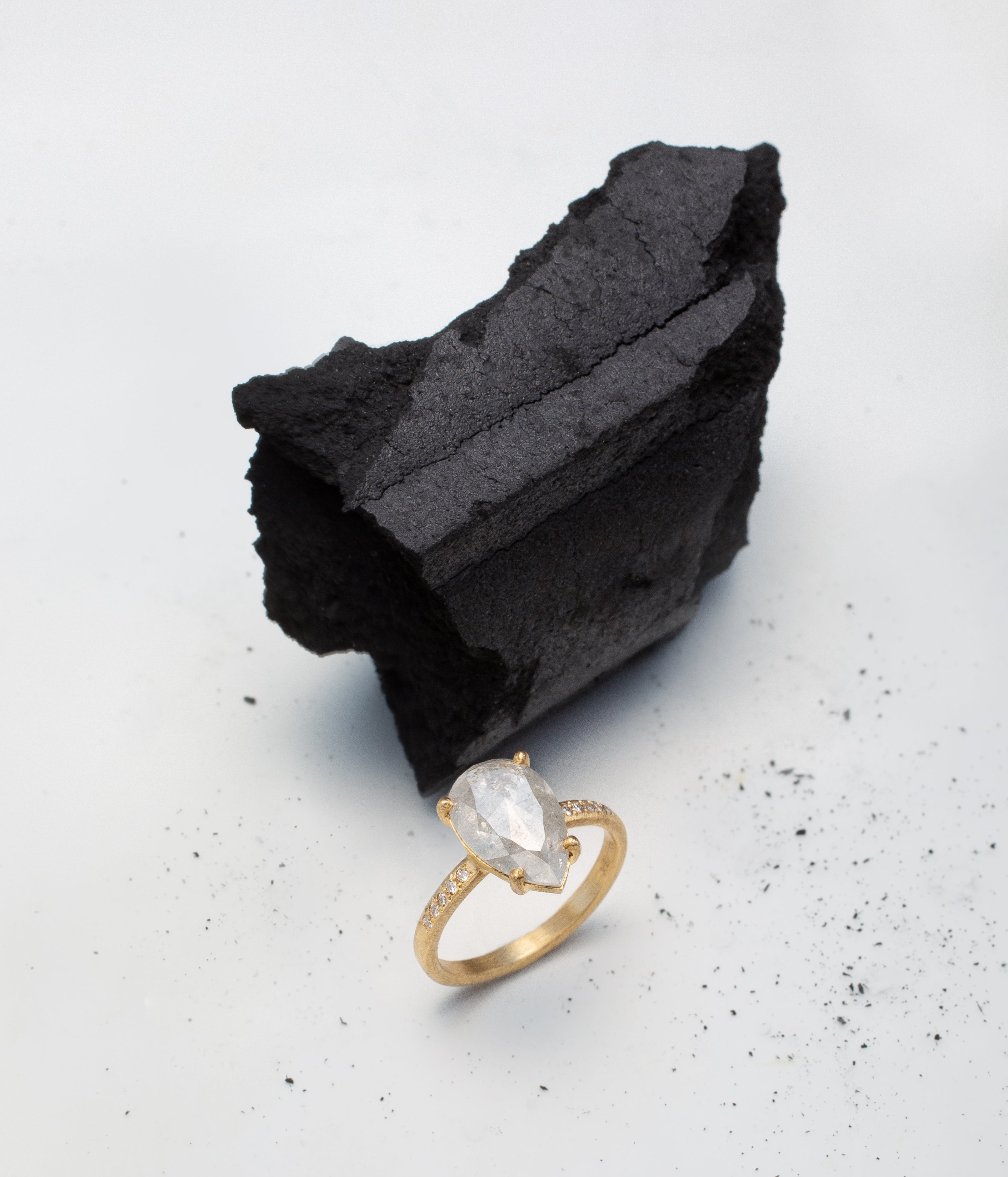
In 2026, champagne diamonds are gaining new recognition. Once undervalued, their golden, cognac or honey tones are now being reappraised. This is an aesthetic WHITEbIRD has embraced from the beginning. Champagne and salt-and-pepper diamonds are the signature of a house that believes true beauty lies beyond convention.
In a pure diamond, carbon atoms form a perfect, transparent crystal lattice. When this structure is altered by a chemical element, structural distortion or natural radiation, colour appears and with it, a different kind of rarity.
Nitrogen tints diamonds yellow or brown. Boron creates the rare blue diamonds. Pink diamonds remain partly mysterious, their colour likely caused by structural distortion under immense pressure. Green diamonds, perhaps the most fascinating, owe their colour to natural radiation over millions of years, stones literally coloured by time. Among fancy colours, red is the rarest, followed by blue, violet and pink.
Cutting these stones requires a different expertise. Each shape interacts uniquely with colour, and the cutter must choose not to maximise brilliance, but to bring the hue to life.


SALT-AND-PEPPER DIAMONDS: IMPERFECTION AS A SIGNATURE
There are diamonds that traditional jewellery once rejected. WHITEbIRD chose them.
Salt-and-pepper diamonds, rich in inclusions, reveal fragments of carbon, internal clouds, black or grey specks. Each stone is entirely unique.
Once considered “imperfect”, they now define a new contemporary aesthetic. They appeal to those who find beauty in singularity rather than perfection.
Set by designers such as Noguchi, Karen Liberman, Cathy Waterman or Yasuko Azuma, these diamonds reveal a different light: softer, more mysterious, sometimes more captivating than a flawless white stone.

THE DIAMOND CUTTER: READING THE STONE
Each diamond is the result of a dialogue between hand and material.
Behind every diamond is an exceptional artisan. The diamond cutter transforms a rough crystal into a finished gem. A craft of precision, passed down through generations, centred in Antwerp, Tel Aviv, Surat and Amsterdam.
Cutting a white diamond demands absolute rigour: reading the stone, identifying its natural planes, balancing weight and brilliance. A fraction of a degree can change everything.
Cutting a coloured diamond is another challenge entirely. Each shape influences colour differently. The cutter must decide how the hue will live. With salt-and-pepper diamonds, inclusions add complexity, requiring careful navigation to preserve both structure and character.
ETHICS: WHERE DO OUR DESIGNERS' DIAMONDS COME FROM?
Choosing a diamond today also means choosing how it was sourced. At WHITEbIRD, we pay close attention to the origin of every material used by our designers. Most diamonds we present are responsibly sourced, recycled, or certified under the Kimberley Process, ensuring traceability and preventing conflict financing.
WWAKE, for instance, works exclusively with recycled diamonds, restoring value to stones already in circulation.
Beyond certification, WHITEbIRD selects designers who share a common commitment: knowing the origin of their stones, working with responsible partners, and contributing to an ethical approach to jewellery.
If you need guidance in choosing your diamond piece, our experts are here to assist you, in our Paris boutiques or through private remote appointments.

Ruth Tomlinson's atelier
Setting of a diamond on a We by WHITEbIRD Aurore ring
WHITEbIRD PARISIAN BOUTIQUES
38, rue du Mont Thabor - Paris 1
+33 (0)1 58 62 25 86
boutique@whitebirdjewellery.com
7, boulevard des filles du calvaire - Paris 3
+33 (0)1 40 24 27 17
boutiquemarais@whitebirdjewellery.com
62, rue des Saints-Pères - Paris 7
+33 (0)1 43 22 21 53
boutiquesaintsperes@whitebirdjewellery.com
Boutique
opening hours
Mon: 2:00 pm - 7:00 pm
Tue-Sat: 11:00 am - 7:00 pm
